Someone You Might Know
A memorial for a friend who taught me backgammon

There are some people who simply take up more space than others, not rudely but generously, as if they’ve been allocated extra cubic feet of atmosphere to work with. Matt was like that. Tall, portly (but carrying it well, as my mum would say), from a theatrical family in a town that didn’t have many of those. The sort of boy whose house you could turn up at after school, unexpected, and somehow end up staying for dinner while the mums sorted it out over the phone.
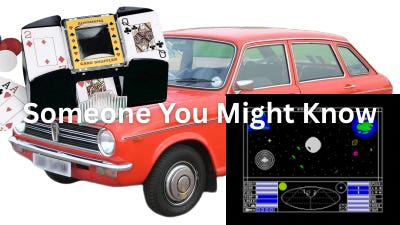
He taught me to play backgammon in the playing fields while other boys were smoking behind the bike sheds. He had an automatic card shuffler that felt impossibly sophisticated. This is about him, and about being young and odd together, and about the friendships that shape you even when they don’t last.
The Theatrical Family
Matt came from what you might call an unusual household for 1980s Falkirk. His father was a photographer, his mother an actress, his older sister training to follow in her theatrical footsteps. They were Jewish, which made them even more of a rarity in a small Scottish industrial town. They lived in a large house in the fashionable part of town, though I’m not sure Matt ever seemed particularly aware of any of this making him different. Or perhaps he was, and simply didn’t care.
They were the sort of family that just welcomed people. Not in a performative way, but as if an extra person at the table was simply what happened. You could turn up after school and somehow end up staying for tea. Mums would phone mums, lifts would be arranged, and nobody seemed to mind. This was extraordinary to me, coming from a more solitary home life. Matt’s house had noise and warmth and people coming and going, and I was drawn to it like a moth to a particularly theatrical flame.
I was invited to his bar mitzvah when we were thirteen or so. Not the religious ceremony, but the party afterwards. It was enormous, the sort of celebration that dwarfed even my parents’ fairly wild New Year’s gatherings, which were themselves legendary in their own small way. There was proper catering, a DJ, what felt like hundreds of people. The whole thing was sophisticated beyond anything I’d experienced.
And where did Matt and I spend most of this lavish celebration? In his bedroom, playing with his automatic card shuffler.
I’m not sure what this says about us, really. Here was this massive party happening downstairs, probably costing a small fortune, adults drinking and dancing and being festive, and we were upstairs, mesmerised by a battery-powered device that shuffled playing cards. It felt impossibly American, impossibly modern. You put the cards in, pressed a button, and they emerged shuffled. Perfect for poker or rummy or whatever game required shuffled cards. We must have run through several packs that evening, just watching it work.
Looking back, I think we both knew we were supposed to be downstairs being sociable, but neither of us was particularly good at that sort of thing. The automatic card shuffler gave us permission to be exactly where we wanted to be.
The Memorial
Matt’s father died suddenly when we were in the early years of high school. Matt was the youngest in his family, like me, with two older siblings. His was the first parent death any of us had experienced, and we were entirely unequipped for it. Fourteen-year-old boys don’t have a manual for this sort of thing.
What do you do when your friend’s father dies? We had no idea. So we did what seemed natural, which was to just carry on being there. Turning up at his house after school. Playing cards. Getting lifts home. The welcome never changed, even as everything else must have been falling apart behind the scenes.
They organised a memorial event at the town hall, which also doubled as the local theatre. I’d performed there myself a few times over the years: choir competitions we’d won, Scottish country dancing displays, bits of musical theatre. I knew that building, its particular acoustics and the bounce of its wooden floor. The foyer was given over to an exhibition of Matt’s father’s photography, a retrospective of his work. It was beautifully done, professional, the sort of thing you might see in a proper gallery.
Then we went into the theatre itself for speeches and memories. This was already more public than most Scottish families would manage. Death was usually a private thing, spoken about in hushed tones if at all. But this family didn’t do hushed tones.
And then Matt’s mother performed.
The welcome never changed, even as everything else must have been falling apart behind the scenes.
She was a theatre actress rather than television or film, and one of her specialisms was music hall songs in the old Good Old Days style. That’s what she did at her husband’s memorial. Her and her troupe, on stage, performing bawdy comic songs about life and love and loss. It was magnificent. Bold and alive and utterly itself.
Matt was mortified, of course. Especially during the more risqué numbers, watching his mother belt out double entendres to a crowd that included teachers and family friends and business associates. But I think he was secretly pleased too. Proud, even, that his mum could stand up there and be so defiantly, theatrically herself while grieving.
It was the sort of memorial that matched the life, I suppose. Public and warm and unafraid of emotion. Nothing hushed about it at all.
Backgammon and Other Diversions
The friendship continued, as friendships do when you’re young and geography keeps you together. We had our little group, four or five of us, and we’d find a spot in the playing fields at lunchtime to sit and play cards and backgammon. While other boys were playing football or smoking behind the bike sheds, we were huddled over a backgammon board like peculiar pensioners.
Matt taught me the game. I was good at it, all strategy and probability, the sort of game that suits a methodical mind. He also taught me poker, which I was terrible at. Couldn’t bluff to save my life. My face gave everything away, apparently. But backgammon, that I could do.
There was something rather civilised about it, sitting in the grass with a proper backgammon set, moving the pieces and working out the odds. It felt sophisticated in a way that school rarely did. The sort of game Matt’s parents probably played at dinner parties. Very different from the chaos happening elsewhere on those playing fields.
As we moved into senior school, different subject choices and different classes made keeping the group together more difficult. But we always tried to make time for the backgammon and cards.
One year I decided I’d had enough of school dinners and convinced my mum to make me packed lunches instead. She was absolutely thrilled, naturally. But it meant I could slip away at lunchtime, and I started going round to Matt’s house. Just the two of us, playing Elite on his ZX Spectrum or playing the Marvel Superheroes role-playing game.
Elite was one of those games that could consume entire afternoons. Wireframe spaceships, trading between star systems, trying to dock at the space station without crashing into it. Hours of your life gone to a universe made of green lines on a black screen. Matt was better at it than me, but then he had more practice.
His house at lunchtime felt like a sanctuary. My own home life was more solitary, quieter. At Matt’s there were always people around, or the sense that people might turn up at any moment. Comics stacked on shelves, the Spectrum set up permanently, the general comfortable chaos of a family home.
The Austin Maxi
Matt was the oldest in our group, which meant he was first to take driving lessons and pass his test. Having a friend with a car at school was extraordinarily rare. Having a friend with a car when you were still dependent on parents for lifts or waiting for buses felt like unimaginable luxury.
The car was an elderly Austin Maxi, passed down from his uncle. Not exactly glamorous, but it might as well have been a Porsche for how it changed things. Suddenly we had freedom. We could go to the shops when we wanted. We could escape.
I’d like to tell you we had grand adventures in that Maxi, drove to the coast or explored the countryside or got up to teenage mischief. But the reality was we were drowning in exam stress by that point. Fifth and sixth year, Highers and university applications, that particular pressure cooker of Scottish education. Life was too full of revision and worry for much actual fun.
Which is probably why those lunchtime visits to Matt’s house felt so precious. A break from all of it. An hour or so of Elite and Spiderman and just being with someone who understood that school felt relentless and that sometimes you needed to hide in a wireframe universe for a bit.
The Drift
School ended the way school does, depositing us all into different futures. I went to college in Falkirk to study communications. Matt went to university, though I can’t remember where or what he studied. We’d bump into each other occasionally in town, have those slightly awkward conversations where you realise you don’t quite know how to talk to each other without the structure of school around you.
We never made firm plans to meet up properly. I’m not sure why, exactly. It’s never just one reason, is it? Partly we were both busy building new lives. Partly going backwards felt complicated. Partly at nineteen you’re not very good at maintaining friendships that aren’t immediately in front of you.
After college I left Falkirk for Aberdeen to start work. I knew Matt had graduated and joined his brother running their uncle’s business. When I came home for holidays I could have sought him out. The town wasn’t that big. But I never did.
The friendship moved from present tense to past tense without either of us really noticing when it happened.
Then I got into my first relationship in Aberdeen and went home even less. Falkirk started to feel like somewhere I’d escaped from rather than somewhere I belonged. Not because of Matt, or any specific person, but because of everything that town represented about who I’d had to be there.
Matt stayed. That was his choice, his life. Rooted in the place, in the family business, building something different from what I was chasing. Neither path better or worse, just different.
The friendship moved from present tense to past tense without either of us really noticing when it happened.
Someone You Might Know
About ten years ago, Matt appeared on Facebook as one of those algorithmically generated suggestions. “Someone you might know.” Which was technically accurate, if a bit reductive for someone who’d taught you backgammon and let you hide in his bedroom during his bar mitzvah and drove you to the shops in an Austin Maxi.
We exchanged a few messages, catching up in that slightly stilted way you do online. All our parents were dead by then, which was sad to hear about his mother. That theatrical force of nature, gone. Matt was living in Edinburgh with his girlfriend. He and his brother had closed the business and sold the premises to a property developer. I imagined they’d done well out of it, though we didn’t discuss money.
We made vague plans about meeting up. But I was in Cheshire by then, and visits to Scotland were rare and usually crammed with family obligations. The plans never quite solidified into actual dates and times.
The messages became less frequent. Life carried on.
Then a little while back I had one of those random thoughts you get occasionally. I realised I hadn’t heard from Matt in a while, hadn’t seen any of his posts. So I looked at his Facebook profile.
He’d died suddenly the previous year.
There it was, written in past tense by people I didn’t know. Tributes from Edinburgh friends, colleagues, his girlfriend. A whole community of grief I wasn’t part of. No one had any reason to tell me. Our connection was purely digital by that point. I’d become someone from his past, not his present.
I sat with my laptop for a while, scrolling through the comments, trying to piece together what had happened. Another sudden death in that family. His father in the early 1980s when we were barely teenagers. Matt himself sometime in his late forties. Both of them gone too soon, too suddenly.
Two Griefs
When Matt’s father died, we navigated it together. We were teenagers with no idea what to do, so we did the only thing we could think of. We just showed up. Played cards. Ate dinner at his house. Let life carry on around the enormous fact of it. We went to that remarkable memorial where his mother sang bawdy music hall songs and Matt cringed and glowed in equal measure. We were useless at grief, probably, but we were there.
When Matt died, I navigated it alone, a year late, through a Facebook profile. No gathering, no memorial, no music hall songs, no automatic card shuffler to hide behind while the adults sorted things out. Just silence and the peculiar disconnected feeling of grieving someone who was already past tense before you even knew they’d died.
This is what being in your fifties means, I suppose. Your parents’ generation has mostly gone, and now it’s starting to be your peers. The first friend from school. Not the last, either. But there’s no group of odd boys in the playing fields to muddle through it with this time. We’re all scattered across the country, living separate lives, connected only by algorithms suggesting we might know each other.
His family understood something about rituals for grief. They made his father’s death public and bold and unafraid. They performed it, literally. It gave us something to witness, something to hold onto.
When Matt died, I got none of that. Just the past tense on a screen and the regret of missed coffee dates we’d vaguely discussed but never quite managed.
What He Gave Me
So this is the memorial I didn’t get to attend, written in the spirit I imagine Matt’s mother would approve of. Not maudlin, not precious. Just honest about what he was and what he meant.
Matt taught me backgammon in the playing fields while other boys were doing more conventional teenage boy things. He showed me what it looked like when a family was warm and welcoming and unafraid of being different. His house was the first place I experienced that particular kind of casual acceptance. Turn up, stay for dinner, nobody minds.
He had an automatic card shuffler that we played with during his bar mitzvah instead of socialising properly. He drove an Austin Maxi that felt like freedom even if we only went to the shops. He let me hide at his house during lunchtimes, playing Elite and reading comics, when school felt too much.
He was there during those years when I was working out how to be odd in a world that didn’t make much space for odd boys. He never made me feel like I needed to be different from what I was. Neither did his family. That matters more than I probably realised at the time.
We navigated his father’s death together, uselessly but sincerely. I had to navigate his death alone, which felt wrong somehow. As if I’d missed something important by not being there, by letting the friendship drift into past tense while we were both still alive.
But perhaps that’s the nature of these early friendships. They shape you, teach you things, give you refuge when you need it. And then life moves you in different directions and the connection becomes something you used to have rather than something you currently do. It doesn’t make them less important. It just makes them belong to a specific time and place and version of yourself.
Matt was larger than life in all the best ways. Generous with space and time and warmth. From a family that knew how to grieve boldly and love loudly.
I’m glad I knew him. I’m glad his house was there when I needed it. I’m glad he taught me backgammon.
I wish I’d managed that coffee.
💬 If this resonated, I’d love to hear about your own friendships that belonged to a specific time, the people who shaped you and then drifted away. Leave a comment or share this with someone who might understand.
✉️ Subscribe for more essays on memory, friendship, and the particular oddness of growing up different in small towns.
-----